
Rosetta Stone vs Duolingo: Sometimes it is harder to select some apps for learning a new language than actually learning it because many platforms are available with the same purpose.
Rosetta Stone and Duolingo are some of the most discussed apps in this area. We’ll compare Rosetta Stone vs Duolingo here to help you make a wise decision.
Rosetta Stone uses images, audio, and target language context to help you understand without depending heavily on translation. Duolingo has a large library of exercises and divides them into a gaming experience through streaks, XP, quests, and rewards.
They offer lessons through mobile apps and web browsers. But their learning style is a little different. Although suggesting you use a single platform for learning a new language is not enough, both softwares are perfect for different kinds of purposes.
Different learners indeed have different learning priorities. Some may prefer learning a few minutes daily for free. But others may need a more structured course. This comparison will give you a clearer idea about which app fits your learning goals.
Rosetta Stone vs Duolingo: Quick Comparison Table
| Feature | Rosetta Stone | Duolingo |
| Strengths | Visual learners and organized learning | Free daily practice and motivation |
| Learning style | Engaging with images, audio, and context | Gamified exercises & repetition |
| Languages | 25 languages | More than 40 languages |
| Lesson length | Small activities under a structured course | It usually takes around a few minutes |
| Pronunciation | Strong TruAccent feedback | Basic speaking recognition and richer tools on Max |
| Grammar | Learn through examples and patterns | Guidebooks and explanations in some courses |
| Free plan | No | Yes |
| Paid plan | $19.99/month or $159/year | Super and Max plans available |
| Offline learning | There is no clear promise for current Sapphire | It is supported with cached content varying |
| Gamification | Less | Strong streaks, XP, quests, and leaderboards |
| AI features | Chat Missions and Sapphire Studio | Roleplay and Video Call with Max |
| Why You Should Use? | Structured language learning | Casual, consistent practice |
Rosetta Stone vs Duolingo: Key Features
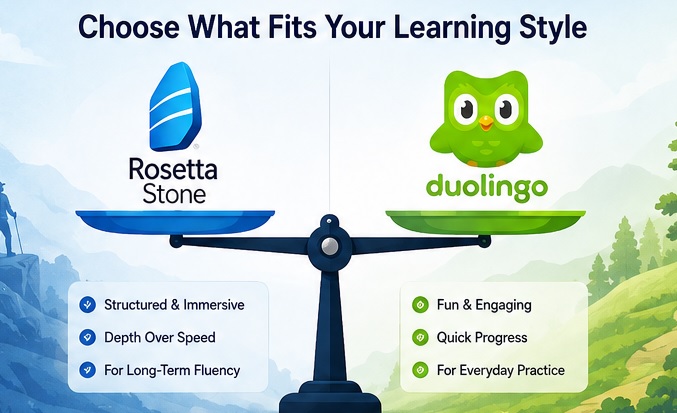
Now, let’s us discuss key features of these two amazing language learning apps;
Rosetta Stone Features
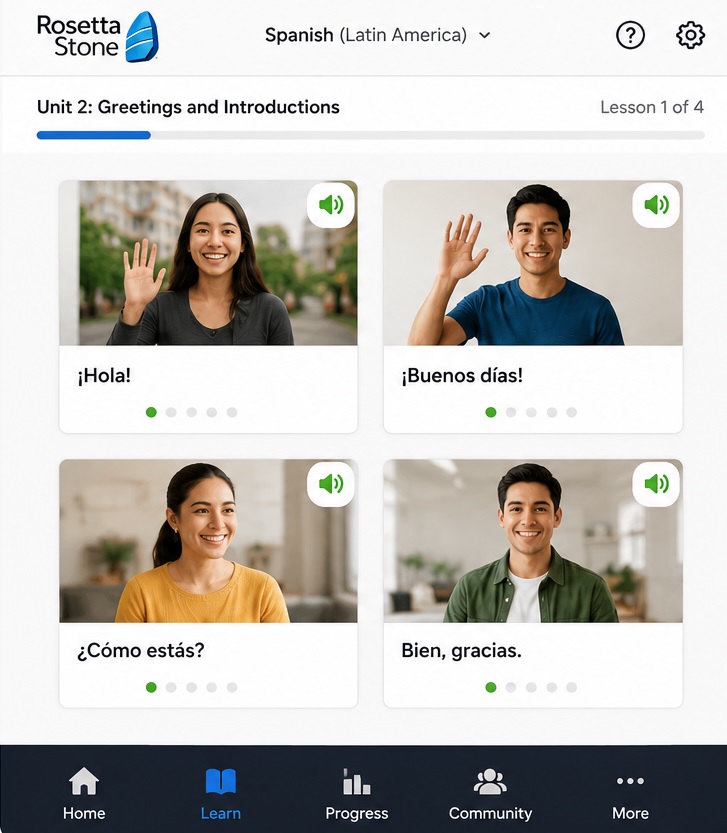
It follows an immersion-focused approach called Dynamic Immersion. Rosetta Stone’s lessons use images, audio, and context to help users understand the meaning.
1. Dynamic Immersion
It is one of Rosetta Stone’s biggest features. Lessons introduce vocabulary and grammar through images, audio, and practical situations. Learners also use context to understand the meaning easily without translating it.
2. TruAccent Pronunciation Feedback
It is a speech-recognition technology. It listens while you speak words and phrases to give you fast feedback.
3. Structured learning path
It covers these topics in its clear course:
- Vocabulary
- Listening
- Reading
- Writing
- Speaking
- Pronunciation
- Grammar through context
They’re organic around real-life themes. They can, however, make the course feel like an old language program.
4. Flashcards and Chat Missions
The current Sapphire subscription also has extra study tools:
- 500+ themed Flashcard sets
- Chat Missions for text-based conversations
- Sapphire Studio to create personalized practice materials
They give you more ways to review material outside the main course.
5. Live Tutoring
Rosetta Stone also offers live tutoring within its paid plan. Sessions are created around the learner’s goal to give them extra practice chances and feedback.
Duolingo Features
Duolingo takes a more enjoyable path to help you learn new languages. Its lessons combine different exercise types. It is perfect for short daily sessions.
1. Short sessions
Anyone can complete lessons within a few minutes on Duolingo. This is why it is perfect for those with a busy schedule. You can complete one lesson and stop or continue your study with several lessons based on your free time.
2. Gamification
Duolingo makes its learning lessons easier through its game-like lessons. It uses:
- XP
- Streaks
- Quests
- Leaderboards
- Rewards
- Characters
- Daily goals
They encourage students to keep learning regularly without any distractions.
3. Multiple exercises
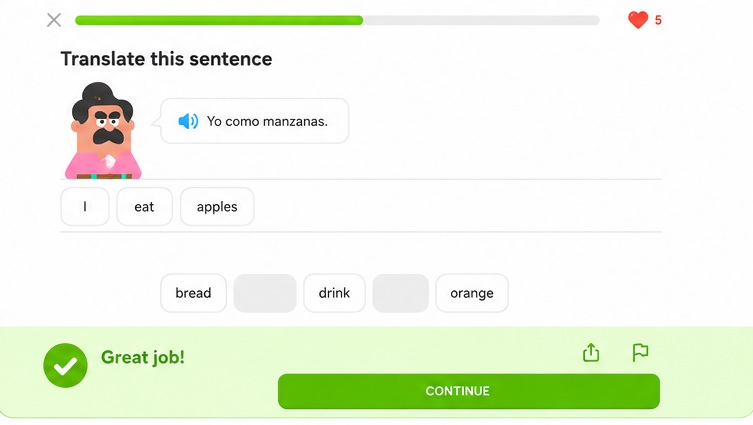
It offers the combination of:
- Translation
- Listening
- Reading
- Writing
- Speaking
- Matching
- Fill-in-the-blank exercises
It makes learning more engaging compared to Rosetta Stone’s image-based exercises.
4. Large language selection
Duolingo offers more than 40 languages for its learners. Spanish and French are some of its popular language learning courses. Scottish Gaelic, Hawaiian, and Navajo are examples of its less popular languages. It is a clear winner over Rosetta Stone in this area.
5. Free example
Its free courses are one of Duolingo’s biggest advantages. You can study without paying for a subscription. Although the free version might have ads and feature limits based on the account, it can be removed using a paid plan.
6. AI conversation tools
AI-based Roleplay and Video Call in supported courses are also available in Duolingo Max. Paid users will therefore get more opportunities for interactive conversation.
Pros & Cons: Rosetta Stone vs Duolingo
Rosetta Stone and Duolingo have their own strengths and weaknesses. It would be easier to select the right app after understanding them.
Rosetta Stone
| Pros | Cons |
| Images and contexts play an important role in lessons | It doesn’t fully offer complete course access for free. |
| Better pronunciation feedback via TruAccent | Some activities might start to feel repetitive |
| A clear sequence through the Learning Path | Reward system is a major missing |
| Main lessons depend heavily on a certain language | Chat Mission is completely text-based |
| A subscription gives you access to all 25 languages | TruAccent doesn’t provide a long-term score. |
| Advanced learning features are available. |
Duolingo
| Pros | Cons |
| You can study without paying a single penny | The standard courses use more translation and English instruction |
| Most activities can be completed within a few minutes | Basic pronunciation feedback |
| Gamification encourages regular learning | Limited free plan |
| It offers more than 40 languages to learn | Some phrases are weird |
| Listening, speaking, reading, writing, translation, and matching | |
| AI features are also there. |
Rosetta Stone vs Duolingo: Pricing
Subscription cost is one of the important factors to select between Rosetta Stone vs Duolingo. Both have different pricing models from each other.
Pricing of Rosetta Stone

Although it is a paid language-learning platform, it offers a trial through its mobile apps. Check their premium plan here:
- Monthly: $19.99
- Annual: $159
- Languages: All 25 languages
- Mobile trial: One-time 7-day trial
- Direct purchase guarantee: 14-day satisfaction guarantee.
The annual plan is comparatively cheaper than the monthly plan for 12 months. As all 25 languages are accessible with a premium plan, it is ideal for those looking to learn more than 25 languages.
An additional purchase might be needed for its live tutoring. You can enjoy five 30-minute sessions at $279 and ten sessions at $399.
Read Also,
Memrise vs Duolingo: Which Is Better?
Memrise Review: Is Memrise Pro worth it?
Pricing of Duolingo
It wins in the pricing comparison because it offers a main course for free.
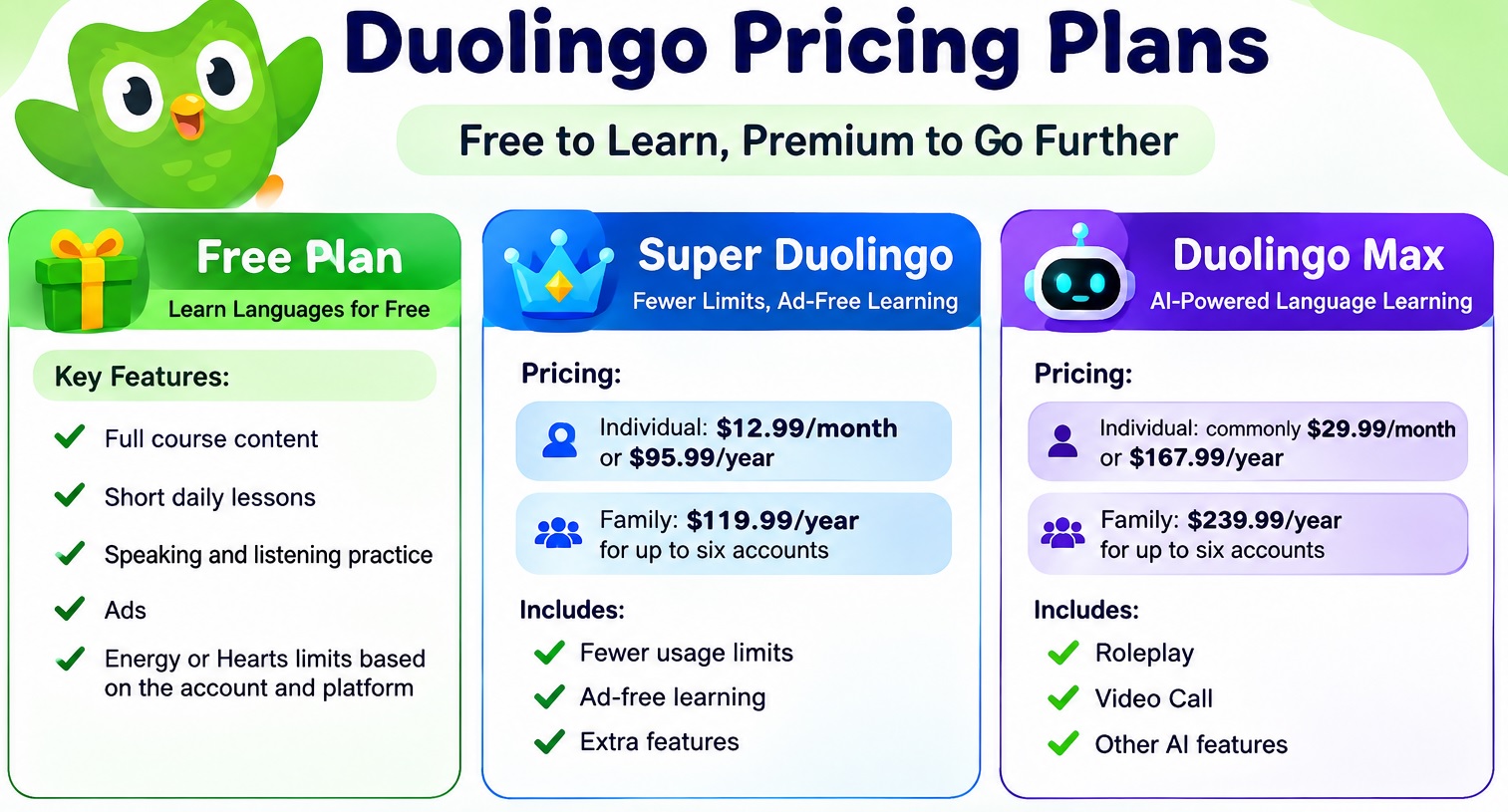
Free
The free plan has:
- Full course content
- Short daily lessons
- Speaking and listening practice
- Ads
- Energy or Hearts limits based on the account and platform
Super Duolingo Pricing
It removes many restrictions from the free experience.
Individual: $12.99/month or $95.99/year
Family: $119.99/year for up to six accounts
It will have fewer usage limits, ad-free learning, and extra features.
Duolingo Max Pricing
It is the highest subscription tier with access to AI-based conversation tools.
- Individual: commonly $29.99/month or $167.99/year
- Family: $239.99/year for up to six accounts
Roleplay, Video Call, and other AI features are part of this plan.
Note: The exact pricing of both apps might not be the same, as pricing changes over time.
Which App Rosetta Stone vs Duolingo, Offers Better Value?
Duolingo is a clear winner as it offers courses for free. Learners who want structured courses might get more value from Rosetta Stone.
Who Should Use Rosetta Stone?
It is a better match for some learning styles and goals.
You can use Rosetta Stone for:
- Learning well through visuals.
- An immersion-focused course
- Structured lessons
- Stronger pronunciation feedback
- Less game mechanics
- Accessing all 25 languages under one subscription
- Additional study tools such as Flashcards and Chat Missions
- Paying for a dedicated language-learning service
It can be useful for learners who want to build a basic vocabulary without English translations.
Who Should Use Duolingo?
It is an ideal option to study new languages without paying a single penny.
You can use it if you:
- Want to learn for free
- Prefer short lessons
- Enjoy streaks, XP, quests, and leaderboards
- Need extra motivation to study regularly
- Want access to more than 40 languages
- Like learning through many exercise types in one lesson
- Want to practice casually throughout the day
- Are interested in AI conversation features through Max
It is especially useful for maintaining daily learning habits.
FAQs to Rosetta Stone and Duolingo
Now it’s time to discuss the most frequently questions asked by the users related to Rosetta Stone vs Duolingo.
Is Rosetta Stone better than Duolingo?
Yes, it is better for structured lessons, visual learning, and stronger pronunciation feedback. Its Dynamic Immersion helps users learn words with images and situations.
Which is better for speaking, Rosetta Stone or Duolingo?
Rosetta Stone excels in this area because it has TruAccent speech-recognition technology. It gives fast feedback when users speak words and phrases.
Is Rosetta Stone free?
No, Rosetta Stone is usually a paid language-learning platform. Users can, however, try the mobile app through a one-time 7-day trial.
Can you learn a language completely with Duolingo?
It can indeed help you learn vocabulary, learn basic grammar patterns, and develop a regular learning habit. Genuine conversations, listening practice, and speaking in the targeted language are more important for becoming fluent.
Can Rosetta Stone and Duolingo be used offline?
You can use a few Duolingo content offline without an internet connection. Rosetta Stone offers offline access with a paid subscription.
Final Verdict
Rosetta Stone defeats Duolingo for serious language learners.
Its structured learning system is the biggest strength. Rosetta Stone uses images, audio, and real-world situations to offer an immersive experience. Duolingo deserves appreciation for making language learning more accessible for free. It also makes learning enjoyable through gamification.
The ultimate winner is genuinely in your hands as you must consider your learning goals and styles.