
Rosetta Stone vs Babbel: Have you decided to remember a new language? It means that you have started your learning journey with your first step.
But many people struggle to find a reliable way to start learning. Learners can now easily start learning new languages, as many mobile apps are available to help them.
Rosetta Stone vs Babbel: Which is Better?
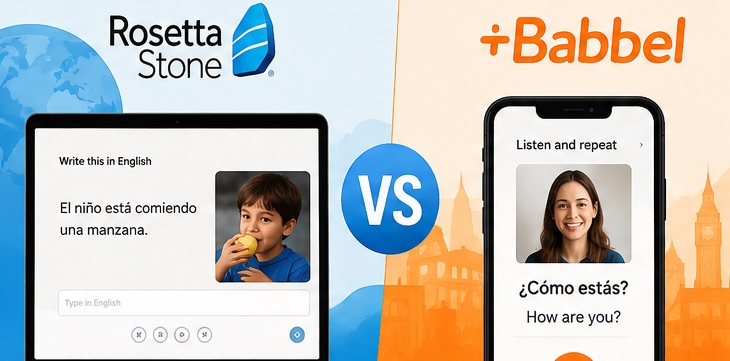
Rosetta Stone vs Babbel comparison is one of the most common battles when selecting the right app. Although they aim to help their users build reading, writing, listening, and speaking skills, they follow very different approaches.
Rosetta Stone offers enjoyable learning methods through pictures, context, and repetition with very little dependence on local language. Babbel, meanwhile, has structured lessons with grammar explanation, translation, and real-life conversation.
The best choice ultimately depends on your learning style, budget, and goals. Some learners enjoy learning through an engaging experience. Others want in-depth explanation and detailed guidance.
This is why it is important to understand the difference between Rosetta Stone vs Babbel. We’ve written this guide to help you select the right app based on your learning needs. You’ll get an in-depth comparison of both apps here based on features, pricing, and other factors.
This comparison will assist you in selecting the right learning app for your needs.
Rosetta Stone vs Babbel: Quick Comparison
| Feature | Rosetta Stone | Babbel |
| Who Should Use | Learners looking for visual and immersion-based learning | Beginners and adults preferring structured lessons |
| Teaching Method | Image-based engaged learning | Guided lessons with translations and grammar explanations |
| Lesson Length | 30–60 minutes | 10–15 minutes |
| Speaking Practice | Strong pronunciation training with speech recognition | Good speaking exercises with guided conversations |
| Grammar Instruction | Learned through context | Explained throughout lessons |
| Languages Available | 25+ languages | 14+ languages |
| Learning Style | Intuitive and enjoyable | Step-by-step and structured |
| Mobile App | Yes | Yes |
| Offline Learning | Available | Available |
| Live Classes | Comes with selected plans | Standard plans don’t have it |
| Free Trial | Limited trial and money-back guarantee | Limited trial and money-back guarantee |
| Starting Price | Around $13/month (annual plan) | Around $/month (annual plan) |
| Best Choice | Learners who enjoy immersion | Learners who want faster and guided growth |
Key Features of Rosetta Stone vs Babbel
These apps have been developed to help users learn some important language skills. But they come with different features. That’s why we have divided the features of both platforms below:
Rosetta Stone Key Features
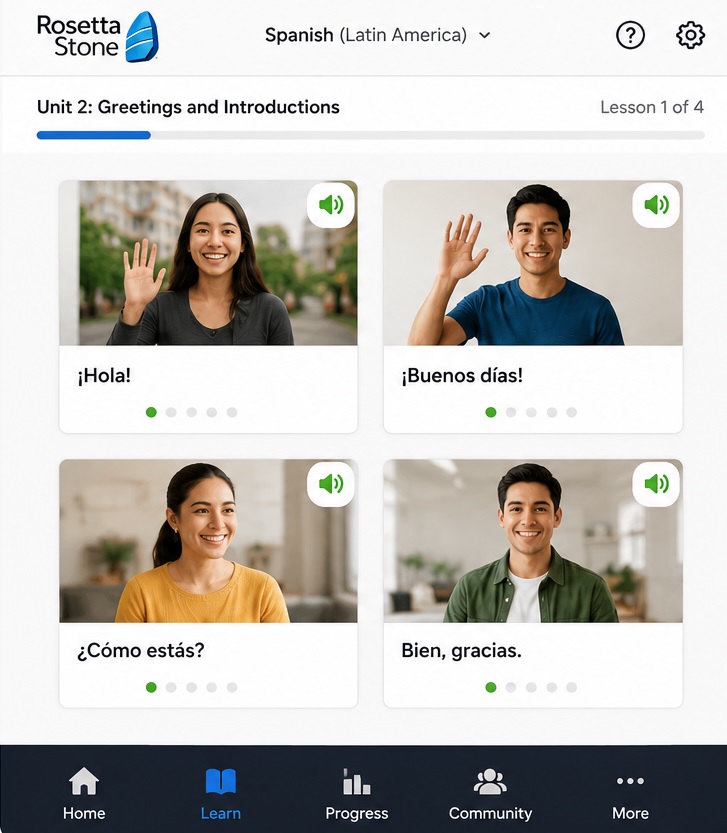
It has been one of the most well-known language learning apps for decades. Rosetta Stone helps its users to develop important language skills by connecting words with images, sounds, and real-life situations.
1. Immersive Learning Method
It uses immersion-style teaching to encourage you to understand new words through pictures, context, and repetition. You can therefore build a direct connection between words and their meanings without translating them repeatedly.
2. TruAccent Speech Recognition
Its pronunciation practice is one of the biggest strengths. Rosetta Stone uses TruAccent speech recognition technology to analyze your ability to pronounce words and phrases.
Its perks are:
- Instant pronunciation feedback
- Practice with native speaker recordings
- Improvement in speaking confidence
- Support for creating clearer pronunciation
3. Wide Language Selection
Rosetta Stone supports more languages than Babbel and other competitors. You can easily learn popular options, like Spanish, French, German, Italian, and Japanese. It also supports many less popular languages.
Some supported languages are:
- Arabic
- Chinese (Mandarin)
- Dutch
- English
- French
- German
- Hindi
- Japanese
- Korean
- Portuguese
- Russian
- Spanish
- Turkish
- Urdu
- Vietnamese
4. Live Coaching and Extra Resources
Rosetta Stone also offers more learning resources based on your subscription plan. Live coaching classes and supportive materials are some of the popular resources available here.
You can also access:
- Phrasebooks
- Audio lessons
- Short stories
- Extra speaking practice
- Progress tracking tools
They help you practice more than regular lessons.
Read Also,
Rosetta Stone vs Babbel vs Duolingo: Which Is the Best?
Babbel Key Features
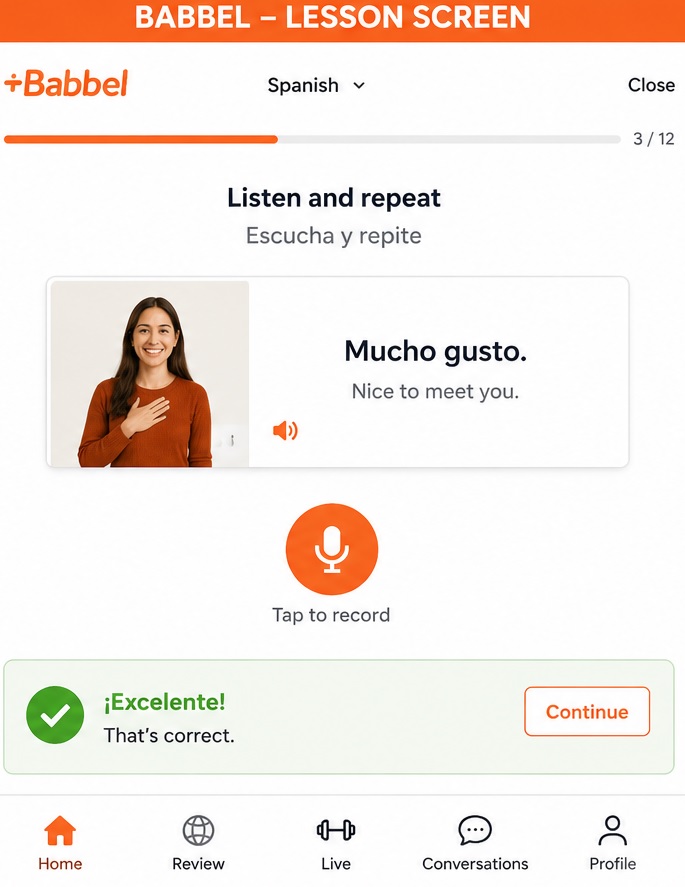
Babbel, on the other hand, combines vocabulary practice, grammar explanations, speaking exercises, and real-life dialogues to create an organized learning experience.
1. Short and Practical Lessons
Its lesson format is one of the biggest advantages of Babbel. Most lessons can be completed within a busy schedule as they last around 10 to 15 minutes. They usually have:
- Listening exercises
- Vocabulary practice
- Speaking activities
- Fill-in-the-blank questions
- Conversation exercises
- Grammar tips
It allows learners to make regular progress without spending hours studying.
2. Grammar Explanations
Babbel defeats Rosetta Stone in this area. It explains grammar concepts during lessons. It can be helpful for learners to understand why sentences or phrases are arranged in a certain manner.
It also introduces grammar concepts slowly through real-life examples without overwhelming its users with complex rules.
3. Speech Recognition Practice
Babbel also uses speech recognition features to let its users practice pronunciation and speaking skills.
You can therefore:
- Repeat phrases
- Improve pronunciation
- Practice everyday conversations
- Receive feedback during speaking exercises
4. Review system
Babbel also uses a clear session to help users remember previously learned words and phrases.
Learners can use these elements in this manner:
- Flashcards
- Listening exercises
- Speaking practice
- Writing activities
It helps you strengthen your vocabulary retention over time.
5. User-Friendly Learning Experience
Babbel also offers a simple dashboard and organized course structure. Users can easily track their growth and select a course based on their entry level. It is especially suitable for beginners because it has a clear learning path.
Rosetta Stone vs Babbel: Pros And Cons
Although Rosetta Stone and Babbel are ideal for learning new languages, they both have their own strengths and weaknesses.
Rosetta Stone Pros and Cons
| Pros | Cons |
| It has a strong focus on pronunciation and speaking skills | Lessons can become repetitive after some time |
| It is a perfect option for visual learners | Beginners may become confused due to fewer translations |
| It offers a large number of language learning courses | More expensive than its competitors |
| Extra learning resources are available | Less grammar explanation |
| Clean and easy-to-use interface |
Babbel Pros and Cons
| Pros | Cons |
| Short lessons help you learn quickly | It supports fewer languages than Rosetta Stone |
| Clear grammar explanation | Speaking practice is affordable |
| More variety in exercises | Less helpful for learners |
| Affordable subscription plans | Advanced learners may find some courses limited |
| Real dialogues focus on practical situations | |
| Strong review system |
Rosetta Stone vs Babbel: Pricing
It is one of the biggest deciding factors for comparison Rosetta Stone vs Babbel. Although they offer multiple subscription plans and discounts, Babbel is usually more affordable for single learners. Rosetta Stone, however, has extra features at a higher price.
Note: You should always verify the exact subscription pricing and offerings before making a purchase, as pricing could change over time.
Rosetta Stone Pricing

Rosetta Stone’s subscription plan offers access to all supported languages.
| Plan | Approximate Price |
| Monthly Plan | $19.99/month |
| Annual Plan | $159/year |
| Lifetime Plan | Available during promotional offers |
You’ll get:
- All-access subscription
- Immersive lessons
- Chat Missions
- Flashcards
Babbel Pricing
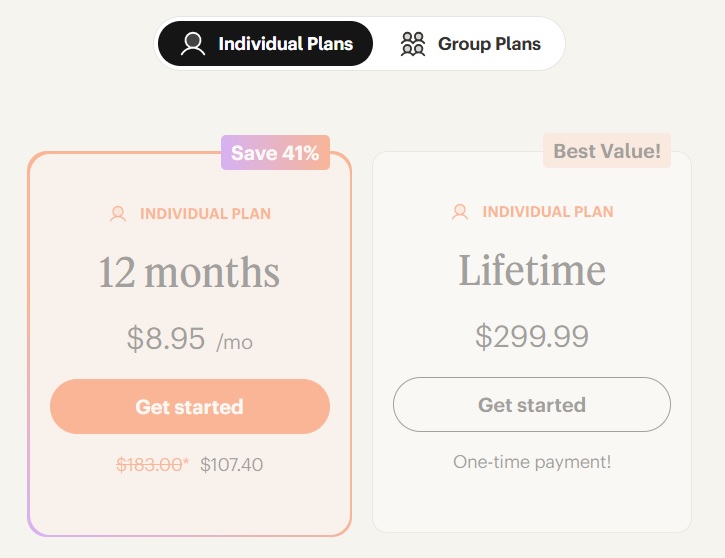
It offers many subscription options to help its users choose a plan based on their budget.
| Plan | Approximate Price |
| 3 Months | $45.75 ($15/month) |
| 12 Months | $107.70 ($8/month) |
| Lifetime Plan | $299.99 (often discounted) |
You’ll get:
- Personalized learning plan
- Audio Recaps & Everyday Conversations
- Immersive Podcasts
- Babbel Speak
Which App Offers Better Value?
Babbel offers better overall value with the lowest long-term cost. It is an ideal choice for most learners due to its structured lessons, affordable annual plans, and regular discounts.
Rosetta Stone offers extra features with a little extra cost. You can use it if you:
- Prefer immersive learning
- Want stronger pronunciation practice
- Need access to a wider range of languages
- Enjoy visual learning techniques
Who Should Use Rosetta Stone?
Rosetta Stone is ideal for learners for discovering through seeing and repetition without depending on translation.
You can use this app to:
- Learn through images instead of text
- Improve pronunciation with speech recognition
- Learn best through immersion
- Plan to study one language for a long time
- Want access to more than 25 languages
- Use visual learning methods for studying
It might not be suitable for those looking for detailed grammar explanations.
Who Should Use Babbel?
Babbel is created to offer a structured course with deep explanations and real conversation. You can opt for this app when you:
- Are completely new to language learning
- Prefer step-by-step lessons
- Want grammar explained in easy language
- Have only 10 to 15 minutes for learning
- Need an affordable subscription
- Learn better with translations and guided practice
- Want lessons focused on practical conversations
FAQs to Rosetta Stone vs Babbel
Is Babbel better than Rosetta Stone?
Yes, it is an ideal choice for most beginners and adult learners. Rosetta Stone, however, can be a suitable option for visual learning and an immersive approach. The right app depends on your learning style and goals.
Which app is better for beginners, Rosetta Stone or Babbel?
Beginners should use Babbel because it explains grammar concepts deeply. It also provides translations and guides users through lessons.
Does Rosetta Stone have more languages than Babbel?
Yes, Rosetta Stone has a bigger library of languages compared to Babbel. It supports more than 25 languages.
Is Babbel cheaper than Rosetta Stone?
Yes, Babbel is more affordable than Rosetta Stone. Its annual plan usually costs around $8. But the same plan is available at approximately $10/month with more advanced features.
Which app is better for speaking practice?
Rosetta Stone focuses more on speech recognition technology. It helps users practice sounds to improve their pronunciation.
Final Verdict
Babbel stands as a clear winner for most language learners. Busy adults and beginners may enjoy it due to structured lessons, practical exercises, grammar support, and affordable pricing.
Rosetta Stone is also an impressive option for immersion-based learning. Visual learners usually enjoy using it because it has image-focused lessons, pronunciation tools, and big language selection.
Although Babbel is our winner in the comparison, the best app completely depends on your learning goals and style. Practice is also important to excel in a targeted language no matter which app you use.